Chapter 1
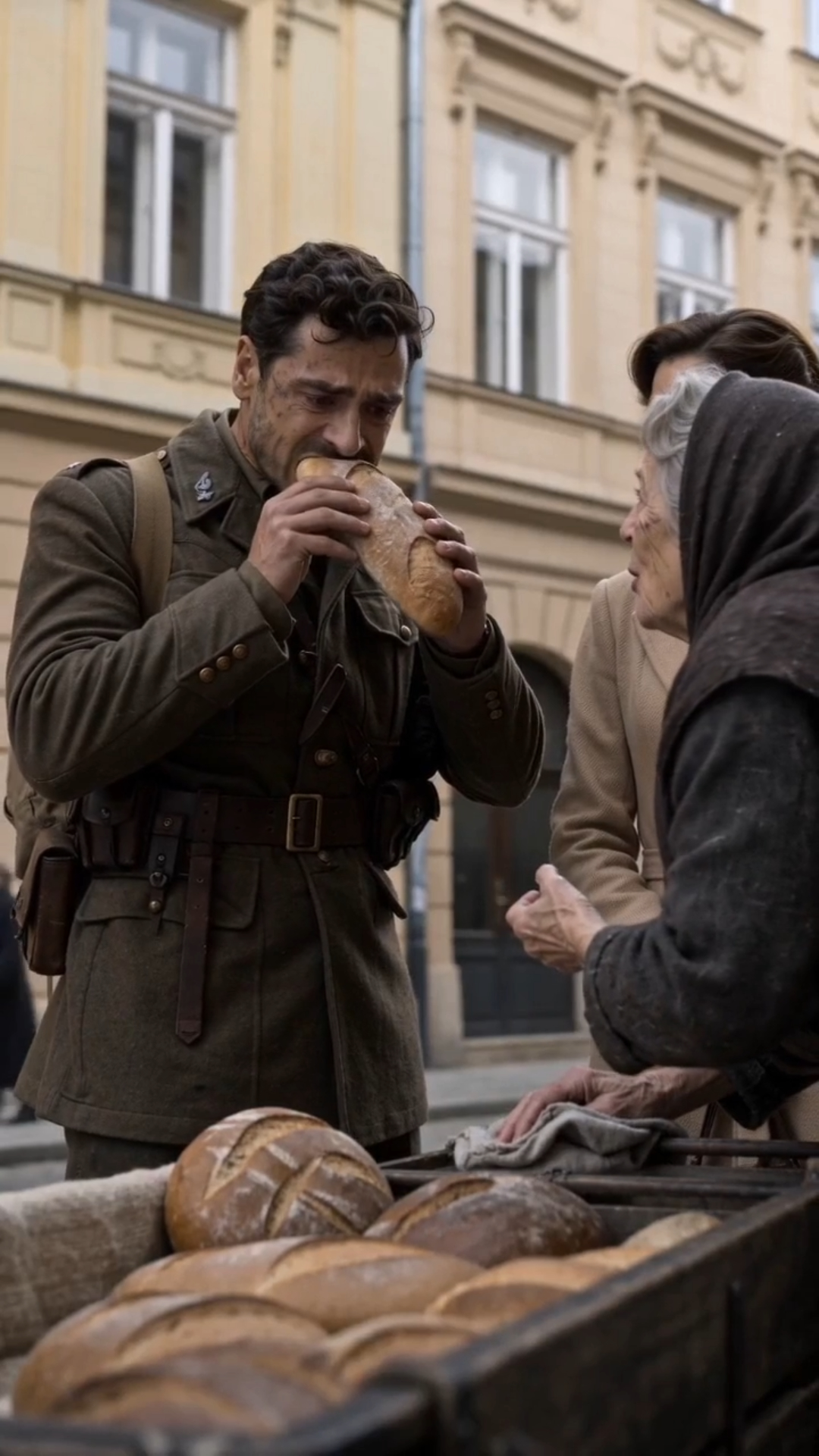
The street was cold, narrow, and gray with dust. A soldier in a worn military coat walked slowly over the old stones, a duffel bag hanging from one shoulder. Beside him walked a graceful woman in a beige coat, gloved and polished, very different from the people crowding the market stalls around them.
He had just returned from war.
People had already begun to whisper his name again.
Captain Adrian Morel. Decorated. Respected. Lucky to be alive.
But Adrian did not look lucky. He looked tired. Hollow. As if part of him had stayed somewhere far away.
Ahead of them, an old woman pushed a small bread cart with trembling hands. Her coat was thin. Her hair was white and loose under a faded scarf. She looked like one more poor soul trying to survive another winter.
Then she saw Adrian.
She stopped so suddenly that one of the wheels struck a stone.
With shaking fingers, she picked up a small loaf from the cart and held it out to him.
“Try it. Please.”
Adrian frowned. He was not in the mood for street bread or pity. But the woman beside him, Elise, touched his arm lightly.
“Take it,” she said. “She’s old.”
Adrian sighed, took the loaf, and bit into it.
At once, his expression changed.
The bread was warm, soft in the middle, with just a little rosemary and pepper folded into the dough. It was a taste he had not known in years, but one he had never truly forgotten.
The old woman stared at him, her eyes wide and wet.
“She made these for you,” she said. “Every morning.”
Adrian froze.
He looked at her more carefully now. At the hands. The eyes. The voice that sounded worn down by time but not erased by it.
The old woman wiped the glass of her cart with a rag. Under the cloudy surface sat a black-and-white photograph.
Adrian picked it up with trembling fingers.
A little boy.
A younger woman.
A small house.
He stared.
The old woman leaned close enough for him to hear her whisper.
“You used to stand right here.”
Adrian’s mouth went dry.
“No,” he said. “This can’t be. Where did you get this?”
The woman looked straight at him, tears slipping down her face.
“You left me here.”
His lips shook.
“Mom?”
And before he could move toward her, someone behind the cart said sharply,
“Madame, don’t talk to strangers. You know what the doctor said.”
Adrian turned.
A man in a dark coat was standing in the doorway of a nearby building, watching them with cold, careful eyes.
Chapter 2
The old woman looked frightened the moment the man spoke.
She stepped back from Adrian as if she had done something wrong. Her hands gripped the cart handle so tightly that her knuckles turned white.
The man in the doorway came forward with the calm confidence of someone used to control.
“Forgive her,” he said. “She gets confused.”
“I’m not confused,” the woman snapped suddenly, surprising everyone. “I know my own son.”
The man smiled, but there was no warmth in it.
“You see?” he said to Adrian. “This happens often.”
Adrian did not answer. His eyes stayed on the woman.
His mother, Marianne Morel, had been declared dead eleven years ago. He had been twenty at the time, newly enlisted, with no money and no power. He had received the letter while stationed near the border. Sudden illness. Quiet burial. No reason to return.
He had believed it.
All these years, he had believed it.
And yet here she was. Frail. Poor. Selling bread in the street.
Elise stepped closer to Adrian. “Who is this man?”
The stranger removed his gloves slowly.
“Dr. Lucien Varel,” he said. “I’ve cared for Madame Morel for years.”
Adrian looked at him sharply. “If you’ve cared for her, why is she living like this?”
Lucien’s expression did not change. “Because she refuses help.”
“That’s a lie,” Marianne said, louder now. “He kept me here.”
Lucien turned to her at once. “You are tired. Let’s go inside.”
Marianne shook her head violently. “No. Not until I tell him.”
Adrian moved toward her. “Tell me what?”
Her breathing became uneven. She clutched his sleeve.
“The day you left… I wrote to you. I wrote every week. But the letters never came back.”
Adrian stared. “I never got any letters.”
“Of course you didn’t,” Lucien said smoothly. “War swallows mail. Everyone knows that.”
But Marianne was crying now.
“Your father didn’t die in the factory,” she said. “He was killed. Because of what he knew.”
The entire street seemed to go quiet.
Adrian’s father had died in an industrial accident when Adrian was a boy. That had been the official story for twenty years.
“What are you talking about?” Adrian asked.
Marianne tried to answer, but Lucien stepped forward.
“Enough,” he said. “She’s upsetting herself.”
Adrian caught the edge in his voice.
Not concern.
Warning.
Then Marianne reached into her apron pocket and pulled out a small rusted key.
She pressed it into Adrian’s hand.
“Under the floorboards,” she whispered. “In the old bakery.”
Lucien’s face went pale.
And Adrian knew, in that instant, that whatever his mother remembered… was true.
Chapter 3
That night, Adrian could not sleep.
He and Elise had taken rooms at a modest hotel across the square. He had spent hours staring at the rusted key in his palm, turning over every memory he had of his mother, his father, and the bakery where he had grown up.
He remembered warmth.
Bread cooling by the window.
His mother singing softly before dawn.
His father coming home dusty and tired, kissing Marianne on the forehead before washing up.
He also remembered the week before his father died.
The arguments.
The fear in his parents’ voices.
His father saying, “If anything happens to me, take the boy and leave.”
Adrian had been too young to understand then.
Now he did.
At midnight, Adrian left the hotel and made his way to the old bakery on Rue Saint-Michel. The building had been abandoned for years. The sign was broken, the windows clouded with grime.
Elise followed him despite his protests.
“I’m not letting you walk into something dangerous alone,” she said.
Inside, the bakery smelled of dust and old wood. The ovens were cold. Shelves leaned at crooked angles. Everything felt frozen in another time.
Adrian found the loose floorboard beneath the back counter exactly where his mother had once hidden emergency money in winter.
He pried it up.
Underneath was a tin box.
Inside were letters. Dozens of them. All addressed to him.
And beneath the letters was a leather ledger and a sealed envelope marked with his father’s name.
Adrian opened the first letter with shaking hands.
My dear Adrian, if you are reading this, then God has finally been kinder than the men around us…
It was his mother’s handwriting.
Every letter she had ever sent.
Every word he had never received.
Elise put a hand over her mouth as Adrian read faster, his face growing harder with every page.
The letters told the story plainly. Adrian’s father had discovered that the Varel textile company, the biggest employer in town, had knowingly used unstable chemicals in its mill. Workers had died. Records were falsified. Bribes were paid. When Adrian’s father threatened to expose them, he was silenced.
The company owner had been Lucien Varel’s father.
And after the death, Marianne had tried to go public.
Instead, she had been declared unstable.
Her property taken.
Her son sent away to war with no way back.
Adrian looked up from the letters, breathing hard.
Elise whispered, “Lucien knew.”
Before Adrian could answer, a floorboard creaked behind them.
A voice came from the doorway.
“More than you realize.”
Lucien stood there, holding a pistol.Chapter 4
Elise gasped, but Adrian stepped in front of her.
Lucien closed the door behind him and kept the gun steady.
“I hoped your mother would die before you returned,” he said. “Old women and loose memories are inconvenient.”
Adrian’s jaw tightened. “You stole her life.”
Lucien gave a small shrug. “I preserved mine.”
He glanced at the ledger in Adrian’s hand.
“That book belongs to my family.”
“No,” Adrian said. “It belongs to the dead workers your family buried.”
Lucien smiled faintly. “And who will believe a soldier with grief in his eyes and a mother the whole town thinks is mad?”
Adrian said nothing.
That was what frightened Lucien.
He was expecting rage. A reckless move. Instead, Adrian seemed calm, almost focused.
Lucien motioned with the gun. “Give me the box.”
But before Adrian could respond, Elise spoke.
“You made one mistake,” she said.
Lucien turned toward her for half a second.
That was enough.
Adrian lunged. The gun fired into the ceiling. Plaster rained down. Elise grabbed a heavy metal tray from the old counter and struck Lucien’s wrist. The gun clattered away.
The three of them crashed into a table, sending old flour tins to the floor.
Lucien fought like a desperate man. Adrian fought like someone who had buried too much already.
When it was over, Lucien lay on the ground bleeding from the mouth, Adrian pinning his arm behind his back.
Outside, voices were coming.
Elise had done more than follow Adrian. Before leaving the hotel, she had quietly sent a note to the local magistrate, along with one of Marianne’s letters and a copy of the first page of the ledger.
Now men entered the bakery with lanterns.
Among them was the magistrate.
And behind him, wrapped in a shawl, stood Marianne.
She looked at Lucien and said with trembling clarity,
“You told me my son forgot me. You told me no one was coming.”
Lucien laughed bitterly through split lips.
“He did forget you. For eleven years.”
Marianne flinched.
Adrian turned to her at once.
“No,” he said. “I was stolen from you.”
Marianne began to cry.
The magistrate took the ledger from Adrian and flipped through it, his face darkening with every line.
“This is enough to reopen the deaths at the mill,” he said. “And enough to arrest Lucien Varel.”
As the constables dragged Lucien away, he twisted his head toward Adrian.
“You think this ends with me?” he said. “You have no idea who protected my family.”
The magistrate looked up sharply.
Adrian felt a cold dread move through him.
Because Lucien no longer sounded like a liar.
He sounded like a man who had just shared only the smallest part of the truth.
Chapter 5
The arrests began the next morning.
Lucien Varel was charged first. Then came two former factory supervisors, a notary who forged death records, and a town clerk who helped seize Marianne’s property. Within days, the story spread beyond the little street where the bread cart stood.
People who had stayed silent for years began to speak.
Widows came forward.
Former workers gave statements.
A priest admitted he had been pressured to sign false burial papers.
The town had not forgotten the dead. It had only been taught to fear the living.
But the deepest wound for Adrian was not the corruption.
It was the lost time.
He sat with Marianne every morning beside her bread cart, even after she no longer needed to push it alone. Sometimes they talked for hours. Sometimes they said very little. Healing did not come all at once. It came like dough rising – slowly, quietly, with warmth and patience.
He read every letter she had written him.
She showed him how she still made the rosemary bread exactly as she had when he was a boy.
Elise stayed too. At first Adrian worried she might decide this old grief was too heavy a burden to marry into. Instead, she surprised him again.
One afternoon, she took off her gloves, rolled up her sleeves, and asked Marianne to teach her the bread recipe.
Marianne laughed for the first time in years.
By spring, the abandoned bakery reopened.
Not as a grand business, but as something honest. A family place. A place where workers ate on credit if they had to, and old women were never called confused when they spoke the truth.
On the first morning it opened, Adrian hung the old black-and-white photograph by the counter.
The little boy.
The young mother.
The small house.
Under it, Marianne placed a handwritten sign:
Welcome home.
Adrian looked at it for a long time.
Then he bent and kissed his mother’s forehead.
He had returned from war expecting to rebuild a future.
Instead, he had recovered a past.
And for the first time since he was a child, when he tasted the first loaf from the oven, the bread did not taste like loss.
It tasted like home.