Chapter 1: The First Kick
The twin boys were supposed to be paralyzed.
Every doctor had said the same thing. Permanent nerve damage. No recovery. No hope. Daniel Whitmore had heard those words from surgeons, neurologists, private consultants, and specialists flown in from Europe. Eventually, the words stopped sounding like diagnosis and became furniture in the house.
Wheelchairs by the window.
Therapy schedules on the wall.
A nursery turned into a medical room.
Silence where running should have been.
So when Daniel walked into the grand, sunlit living room that afternoon, he was not ready for the sound of laughter.
His sons, Noah and Liam, were on the carpet.
Not in their chairs.
Not lying still.
Moving.
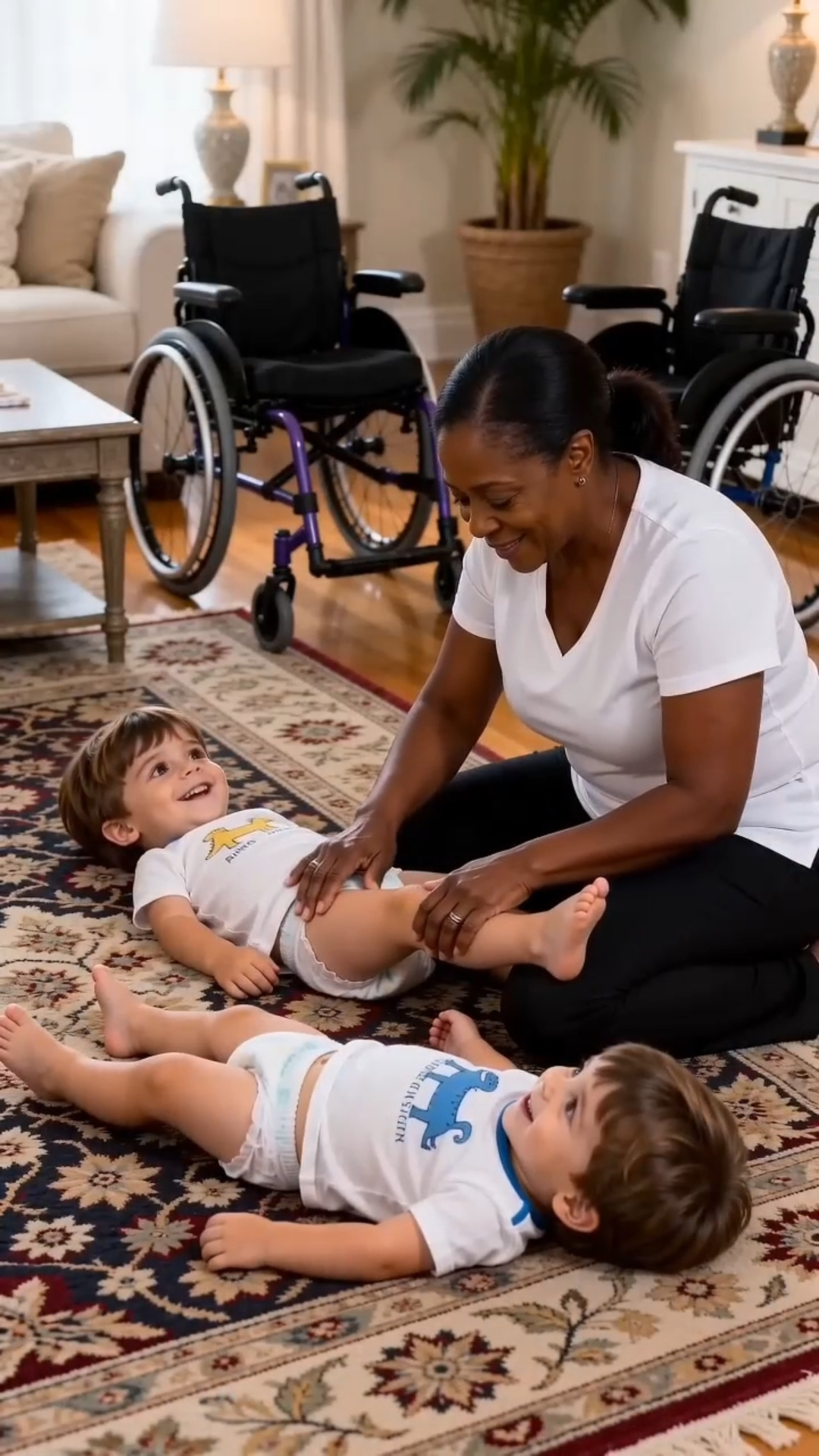
Noah was on his back, laughing as Grace, the housekeeper, gently massaged his legs. Liam lay beside him, lifting one foot toward her hands with an impatient little grin.
“It’s my turn!” Liam said.
Daniel stopped so suddenly that the folder in his hand slipped to the floor.
Grace did not look surprised. She sat calmly on the carpet in her plain gray dress, her dark hair tied back, her hands steady as she pressed carefully along Noah’s calf.
“Easy,” she said softly. “Feel it. Don’t rush.”
Noah giggled and kicked.
Not much.
But enough.
Daniel’s vision blurred.
He turned his head toward the window.
The two wheelchairs stood there.
Empty.
Unused.
For the first time.
He took one step forward. Then another. By the time he reached the boys, his knees had already weakened. He dropped onto the carpet beside them, reaching for their legs, their feet, touching them as if they might disappear.
“You can move,” he whispered. “You can actually move.”
The boys laughed because they did not understand the full weight of his tears. They only understood that their father was happy, and happiness had been rare in that house since the accident.
Grace finally looked up.
Her face was calm.
Too calm.
Daniel turned toward her, still crying. “How?”
She lowered her eyes. “Slow work, sir.”
“Slow work?” His voice shook. “Grace, the best doctors in the world said this was impossible.”
“They said the nerves were dead,” she replied quietly. “I did not believe they were dead.”
Daniel stared at her.
For eighteen months, Grace had been almost invisible in the house. She arrived early, stayed late, prepared meals, read stories to the boys, helped with baths, folded blankets, and moved through grief with the quiet steadiness of a woman who knew how to survive inside other people’s sorrow.
He had trusted her.
But he had never truly looked at her.
Now he saw the calluses on her hands. The careful way she watched the boys’ muscles. The strange sadness in her eyes when she glanced at the wheelchairs.
“What did you do?” he asked.
Grace did not answer immediately.
Before she could speak, a sharp voice cut through the doorway.
“What is going on here?”
Daniel turned.
His mother, Eleanor Whitmore, stood at the entrance of the living room, her silver hair pinned perfectly, her face pale with anger rather than joy.
Her eyes were not on the twins.
They were on Grace.
And when Grace slowly rose from the carpet, Daniel saw something pass between the two women.
Recognition.
Fear.
And a secret that had clearly existed long before this afternoon.Chapter 2: The Woman Who Knew Too Much
Eleanor Whitmore did not enter the room like a grandmother witnessing a miracle.
She entered like a woman finding evidence of a crime.
Daniel noticed it at once. His mother had always been composed, even in disaster. When the boys’ accident happened, she had taken control of the hospital calls, the insurance files, the nurses, the press, and the servants before Daniel could even remember how to breathe. She had told him grief needed structure.
Now that structure was cracking.
“Grace,” Eleanor said, each syllable sharp. “Step away from my grandsons.”
Grace stood still beside the carpet. “I have not harmed them.”
“That is not your decision to make.”
Daniel rose slowly. “Mother, they moved. Noah kicked. Liam lifted his foot.”
“I saw.”
“Then why are you angry?”
Eleanor’s eyes flicked toward him. “Because miracles are often another word for manipulation.”
Daniel stared at her, unable to understand how she could turn this moment into suspicion. The boys had gone quiet now, sensing the tension. Liam pulled himself closer to Noah, and Noah looked from his father to his grandmother with frightened eyes.
Grace noticed first.
She knelt again, not touching them, only lowering herself to their level. “You did nothing wrong,” she said gently. “Neither of you.”
Eleanor’s face tightened. “Do not speak to them as if they belong to you.”
The room fell silent.
Daniel felt the sentence land somewhere deeper than it should have.
Grace looked up.
For the first time since Daniel had known her, something like anger entered her face.
“No child belongs to silence,” she said.
Eleanor stepped forward. “You forget yourself.”
“No,” Grace replied. “I remember too much.”
Daniel moved between them. “Enough. Someone is going to tell me what this is.”
Eleanor turned toward him quickly. “Daniel, send her away. Now. We will call Dr. Pembroke and have the boys examined properly.”
“The boys will be examined,” Daniel said. “But Grace is not leaving until I understand what happened.”
Eleanor’s expression hardened. “You are emotional.”
“Yes,” he snapped. “My sons moved their legs.”
The words broke something inside him again. He looked back at Noah and Liam, trying to smile so they would not be afraid. They smiled back cautiously, and the sight nearly destroyed him.
Grace spoke quietly. “They have had sensation for months.”
Daniel turned.
“What?”
“Small things at first. Heat. Pressure. A twitch in Liam’s toes. Noah could feel when the blanket was too tight. I tried to tell Mrs. Whitmore.”
Daniel looked at his mother.
Eleanor did not deny it.
The room seemed to darken despite the sunlight.
“You knew?” Daniel asked.
“I knew the housekeeper was filling their heads with false hope,” Eleanor said.
Grace’s voice sharpened. “I knew their bodies were trying to wake up.”
Daniel felt cold now. “Why didn’t you tell me?”
Eleanor lifted her chin. “Because you had already suffered enough.”
“No. That is not an answer.”
Before she could respond, Grace moved to the small cabinet near the fireplace and removed a worn notebook from behind a stack of children’s books. She held it out to Daniel.
“Every day,” she said. “I wrote everything down. What they felt. What they moved. What exercises helped. What medicine made them worse.”
Daniel took the notebook with trembling hands.
Pages and pages.
Dates.
Observations.
Careful notes.
And then, near the middle, one name appeared again and again.
Pembroke.
Stopped exercises after visit.
Increased sedative.
Noah slept fourteen hours.
Liam complained legs felt heavy after drops.
Daniel looked up slowly.
Dr. Pembroke was the specialist his mother had insisted on hiring.
Eleanor’s face had gone white.
Grace lowered her voice.
“Sir, I do not think your sons failed to recover.”
Daniel could barely breathe.
Grace looked toward the empty wheelchairs.
“I think someone made sure they wouldn’t.”Chapter 3: Dr. Pembroke’s Diagnosis
Dr. Arthur Pembroke arrived before sunset.
Daniel had not called him. Eleanor had.
That alone told Daniel enough.
The doctor swept into the living room with his leather case, silver spectacles, and the calm authority of a man accustomed to being believed. He greeted Daniel with sympathy, nodded to Eleanor with familiarity, and barely looked at Grace.
The twins sat on a blanket near the fire. Daniel had refused to return them to their wheelchairs. Noah leaned against pillows, tired but glowing with pride. Liam kept trying to move his foot under the blanket, secretly checking whether the miracle was still there.
Pembroke examined them for twenty minutes.
At first, his expression remained professional.
Then Liam’s toes curled.
The doctor’s hand paused.
Daniel saw it.
Noah lifted his knee slightly when Grace encouraged him from across the room. Pembroke’s jaw tightened.
“Well?” Daniel asked.
Pembroke closed his case. “Spasmodic response. Not uncommon. It can create the appearance of voluntary movement.”
“Liam said, ‘It’s my turn,’ and lifted his foot.”
“Children imitate expectation.”
Daniel stepped closer. “Are you saying my sons imagined moving?”
“I am saying grief can make families misinterpret reflex.”
Grace spoke from the wall. “Ask Liam to move his left foot.”
Pembroke turned coldly. “Housekeepers do not direct medical examinations.”
Daniel looked at Liam. “Son, can you move your left foot?”
Liam concentrated, face scrunching with effort.
His left foot shifted.
Only an inch.
But it moved.
The room went silent.
Pembroke removed his glasses and cleaned them slowly. “This is highly irregular.”
Grace’s voice remained steady. “So was the medicine.”
Daniel turned toward her. “What medicine?”
Eleanor snapped, “Enough.”
But Grace had already crossed the room. From her apron pocket, she removed a small brown bottle. “The drops Dr. Pembroke prescribed after each visit. Mrs. Whitmore told me to add them to the boys’ tea. I stopped three weeks ago.”
Daniel looked at his mother. “You drugged them?”
Eleanor’s composure cracked. “They were in pain.”
“No,” Grace said. “They were waking up.”
Pembroke reached for the bottle. Daniel took it first.
“What is this?”
The doctor recovered quickly. “A mild nerve relaxant.”
Grace shook her head. “I showed it to a pharmacist in town. He said it was not for children. He said long-term use could suppress muscle response.”
Daniel’s hand closed around the bottle.
Eleanor looked suddenly older. “Daniel, listen to me. After the accident, you were falling apart. The boys were screaming at night. The doctors said recovery was unlikely. Arthur offered comfort.”
“Comfort?” Daniel said. “Or control?”
Pembroke’s face hardened. “Be careful.”
Grace stepped closer. “No, doctor. You be careful.”
Everyone looked at her.
She reached into the notebook and removed a folded photograph. It showed Grace years younger, standing beside a hospital bed. In the bed was a little girl with leg braces.
“My daughter,” Grace said. “She was treated by Dr. Pembroke seven years ago. He told me she would never walk. He prescribed the same drops.”
Daniel’s anger stalled.
Grace’s voice broke for the first time. “She died in her sleep six months later.”
Pembroke turned toward the door.
Daniel blocked him.
Eleanor whispered, “Arthur, what did you do?”
The doctor looked at Eleanor with contempt.
“What you paid me to do,” he said.
Daniel went still.
His mother staggered backward as if struck.
Pembroke smiled thinly.
“You wanted manageable grandchildren. Not boys running wild with memories of the accident.”
Daniel’s voice dropped. “What memories?”
Pembroke looked toward the twins.
Noah had gone pale.
Liam whispered, “Grandma was driving.”Chapter 4: The Accident
The room became unbearably quiet.
Daniel turned slowly toward his mother.
Eleanor Whitmore stood beside the fireplace, one hand pressed to her chest, her face emptied of every excuse before she could speak one. The twins huddled together on the blanket. Liam had said the words softly, but once spoken, they could not be returned to silence.
Grandma was driving.
Daniel’s voice came out rough. “Mother?”
Eleanor shook her head. “They were five. They were frightened. They do not remember clearly.”
Noah spoke next. “You told us not to say.”
Daniel turned to his son.
Noah’s eyes filled with tears. “You said Daddy would hate us if we told.”
Daniel dropped to his knees in front of them. “No. Never. I could never hate you.”
Liam began crying. “We wanted Mommy.”
The accident had taken Daniel’s wife, Amelia, on a rain-dark road outside the estate. The official story had been simple: Amelia was driving the boys to the country house, lost control, struck the stone bridge, and died before help arrived. The boys survived, but their spinal injuries left them paralyzed.
That was what Daniel had been told.
That was what he had buried his wife believing.
Grace knelt beside the twins. “Tell your father what you remember.”
Eleanor moved sharply. “Do not make them relive this.”
Daniel looked at her. “You do not give orders now.”
Noah wiped his face. “Mommy wasn’t driving. Grandma was. Mommy kept telling her to slow down.”
Liam whispered, “Grandma was angry.”
Daniel felt the floor vanish beneath him.
“Angry about what?”
The boys looked at each other.
Then Noah said, “Mommy said she was taking us away.”
Eleanor closed her eyes.
Daniel stood slowly. “Amelia was leaving me?”
Eleanor’s eyes opened, full of panic. “She was confused. Emotional. She wanted to take the boys abroad. She said this house was suffocating them.”
“Because of you?”
“Because she was ungrateful!” Eleanor’s voice cracked. “I gave this family everything. I protected the Whitmore name after your father nearly ruined it. I managed the estate, the business, the household. Then that girl came in and tried to take my grandsons away.”
Daniel stared at her.
“Your grandsons?”
“My blood.”
“My sons.”
Eleanor’s mouth trembled.
The truth spilled out then, ugly and desperate. Amelia had discovered Eleanor had been quietly moving trust assets into accounts she controlled. She planned to leave Daniel temporarily, take the boys, and force an independent legal review. Eleanor insisted on driving them herself to “talk sense into her.” They argued in the car. The boys screamed. The road was wet. Eleanor lost control.
Amelia died.
Eleanor survived with minor injuries and let the police believe Amelia had been driving.
“And the boys?” Daniel asked.
Eleanor’s voice dropped. “They were so young. But Noah kept saying I drove. Arthur said trauma could fade if reinforced properly.”
Daniel looked toward Pembroke, who was now guarded by two house staff Grace had quietly summoned.
“You drugged them to bury the memory,” Daniel said.
Pembroke did not answer.
He did not need to.
Daniel turned back to his mother. “And when their legs began to recover, you stopped that too.”
Tears slid down Eleanor’s face. “I could not lose them.”
“You already had.”
A crash sounded from the hallway.
Everyone turned.
One of the footmen rushed in. “Sir, Dr. Pembroke’s driver is gone. He took the black medical bag from the hall.”
Grace went pale.
“His records,” she said. “The proof of the prescriptions.”
Daniel moved toward the door.
Then a shout came from outside.
The garage had caught fire.Chapter 5: The Empty Wheelchairs
Daniel reached the garage as flames climbed the side wall.
For one terrible moment, he thought the evidence was gone. Fire roared through the open doorway, eating the shelves where old estate equipment and medical storage boxes had been kept. Staff ran with buckets while the village fire wagon clattered up the drive.
Grace arrived behind him, breathless.
“The records,” she said.
Daniel’s hands curled into fists.
Then he saw Liam.
His son was on the front steps, crying and pointing toward the garden wall.
“The driver went there!”
Daniel ran.
Behind the hedge, he found Pembroke’s driver struggling with a locked iron gate, the black medical bag in one hand. Daniel tackled him into the mud. The bag spilled open across the grass: prescription ledgers, letters from Eleanor, payment receipts, and a sealed envelope labeled Whitmore Children – Memory Management.
The phrase nearly made Daniel sick.
By dawn, police had taken Dr. Pembroke, his driver, and Eleanor into custody. The fire was contained before it reached the house. The evidence survived, though Daniel sometimes wondered if the true fire had been burning inside his home for years, hidden beneath polished floors and family portraits.
The trials took months.
Pembroke’s other victims came forward after Grace testified about her daughter. Families who had trusted his diagnoses reopened old wounds and old cases. Some children had suffered permanent damage. Others, like Noah and Liam, had been kept weaker than they needed to be.
Eleanor did not deny the accident once the boys’ testimony and Pembroke’s records were presented. She insisted until the end that she loved her grandsons. Daniel believed her. That was the worst part. Her love had been real, but it had been a kind of love that devoured.
Grace stayed.
Not as a housekeeper.
Daniel offered her money, a house, anything she wanted. She asked instead to open a rehabilitation center in her daughter’s name, one that treated children whose pain had been dismissed or exploited by powerful doctors. Daniel funded it without putting Whitmore on the sign.
Six months later, Noah took four steps across the living room carpet.
Liam took six, then bragged about it for two days.
They still used wheelchairs sometimes. Recovery was not a fairy tale. There were braces, pain, exhaustion, and long afternoons when frustration made them throw pillows and refuse exercises. But movement returned in pieces, and each piece was treated like treasure.
One spring morning, Daniel wheeled the two old chairs to the storage room.
Noah stopped him. “Are you throwing them away?”
Daniel crouched. “No. I thought we could keep them somewhere else.”
Liam touched one wheel thoughtfully. “They helped us when we needed them.”
Grace smiled from the doorway. “Then they deserve respect.”
So Daniel placed them by the window one last time, not as symbols of defeat, but as witnesses.
The boys stood beside them, holding hands.
Not perfectly steady.
Not cured.
But standing.
Daniel looked at Grace. “You gave them back their lives.”
She shook her head. “No. I only listened when their bodies whispered.”
Daniel thought of Amelia then, of the wife he had failed to protect, and of the sons who had carried the truth in silence until someone gentle enough finally heard them.
That evening, Daniel sat with the boys beneath Amelia’s portrait.
Noah leaned against him. “Daddy?”
“Yes?”
“Will Mommy know we can walk?”
Daniel pulled both sons close.
“I think she knew before any of us.”
Outside, children laughed in the garden.
Inside, the empty wheelchairs caught the sunlight.
And for the first time, they did not look like grief.
They looked like something survived.