Part 1: The Storm Delay And The Auditor’s Instinct
I stood inside the first-class lounge at LaGuardia Airport with a paper cup of black coffee warming my hands, watching early winter snow blur the runway lights into pale streaks beyond the glass, while the departure board quietly rearranged hundreds of lives with the indifferent efficiency of a machine that owed no one an apology.
I was supposed to be on my way to Dallas for a financial technology summit, where I would speak on risk controls, institutional transparency, and the charming fiction that wealthy people always behave rationally when too much money is involved. As Chief Audit Officer of Northbridge Capital, I was paid to trust numbers more than stories, because stories could charm, flatter, distract, and excuse, while numbers eventually exposed whatever people tried to bury beneath expensive language.
Then the announcement came.
“Ladies and gentlemen, due to severe weather conditions, all southbound departures are temporarily suspended until further notice.”
Around me, travelers groaned, executives cursed into their phones, and assistants began rebuilding schedules as if time itself could be bullied into cooperation. I should have been irritated, yet instead I felt a cold, precise current move through me, the kind of instinct that had saved me in boardrooms long before it ever saved me in marriage.
When a process breaks unexpectedly, hidden failures rise to the surface.
My name was Marina Westbrook, and for three years I had been married to Grant Caldwell, a man whose reputation in private equity had been polished until it shone like glass. People called him a strategist, a dealmaker, a man who could turn distressed companies into gold, yet at home he had applied the same logic to our marriage, optimizing affection, scheduling intimacy, and gradually reducing my presence until I became another asset he believed he could manage.
I did not call him.
At first, I told myself I wanted to surprise him, though some quieter part of me knew the truth was less romantic. I wanted to see what existed in my home when no one expected me to enter it.
An hour later, a black car carried me through snow-slicked streets toward our smart estate outside Westport, Connecticut, where every gate, camera, thermostat, lock, and light fixture had been designed to obey a system Grant proudly claimed was impossible to compromise.
He had always loved control.
Unfortunately for him, so did I.
Part 2: The Woman In My Silk Robe
The front door unlocked with a soft electronic click, and the house greeted me with warm lighting, sandalwood, filtered air, and the quiet arrogance of wealth arranged by people who believed comfort was proof of superiority.
At first, nothing looked wrong.
Then I smelled lavender and sea salt.
It was not mine.
I moved through the foyer slowly, heels silent against limestone tile, and stopped at the entrance to the kitchen, where a young woman stood beside the espresso bar wearing my pearl-colored silk robe.
She could not have been more than twenty-six, with loose blond hair, delicate jewelry, and the bright confidence of someone who had never been forced to calculate the cost of trusting the wrong man. She was holding my handmade ceramic mug from Kyoto, sipping tea as though every object in the room had been waiting for her arrival.
When she saw me, she did not panic.
Instead, she smiled.
“Oh, hello. You must be the staging consultant Grant mentioned.”
I felt my heartbeat slow rather than quicken, which was always the first sign that I was no longer reacting as a wife, but observing as an auditor.
“And you are?” I asked.
“I’m Sienna,” she said warmly. “Grant said someone might come by for a final walk-through before the transfer and renovation work begins.”
Transfer.
Renovation.
The words settled neatly into place like false entries in a ledger.
“Did he?” I asked.
Sienna laughed lightly, still unaware that she had opened the door to a room full of consequences. “He said the house had been tied up with a former partner, but everything is finally being resolved. We’re hoping to make it feel less formal once the paperwork is finished.”
A former partner.
I walked past her into the dining room, where a large arrangement of white lilies sat in the center of the table.
Grant had once told me lilies triggered migraines, which was why I had never kept flowers in the house even though I loved them.
Apparently, he was not allergic to lilies.
He was allergic to sharing beauty with me.
Part 3: Metadata Never Learns How To Lie
I moved through the house as if I were conducting a professional inspection, pausing at artwork, shelves, drawers, and small domestic betrayals left carelessly in plain sight.
On the desk in my study, where I had once reviewed acquisition files and regulatory reports, a digital photo frame now displayed a rotating gallery of Grant and Sienna living inside a version of my life.
There they were on a yacht off the Amalfi Coast.
There he was fastening a diamond necklace around her neck in a restaurant I had once suggested for our anniversary, only to be told he was too busy.
There they were in Aspen, in Palm Beach, in Napa, and in a private box at a charity gala I had been unable to attend because Grant insisted the event was canceled.
I touched the frame, opened the image details, and read the dates.
The first series began eleven months earlier.
That was the same week Grant had told me he was in Zurich negotiating an emergency refinancing package for one of our portfolio companies. He had called me every night from what he claimed was a hotel suite overlooking the river, his voice tired, affectionate, and completely rehearsed.
The glass door near the sauna slid open, releasing steam and the scent of peppermint soap into the hall.
Grant stepped out wearing only a towel, his hair damp, his face relaxed in a way I had not seen directed toward me in months.
“Sienna, did you make coffee?”
Then he saw me.
His expression drained so quickly that it seemed almost mechanical.
“Marina,” he said, his voice cracking around my name. “Your flight was canceled?”
Sienna turned sharply toward him. “Grant, why did you call her Marina?”
I closed the folder I had picked up from my desk and looked at him with the professional calm I usually reserved for executives who had just realized the audit committee already knew everything.
“Hello, Grant. I am sorry the snow disrupted your transition plan.”
He stepped forward, one hand lifted as if he could physically slow the collapse. “Listen to me. This is not what it looks like.”
“That is unfortunate,” I said, “because what it looks like is already bad enough.”
Sienna’s face shifted from confusion to alarm. “Grant, who is she?”
I looked at the young woman standing in my robe and holding my mug. “I am his wife.”
The silence that followed was not empty.
It was full of evidence.
Part 4: The Fraud Beneath The Affair
Grant tightened the towel around his waist, as though dignity could be restored through fabric.
“Marina, please,” he said. “I was going to explain everything properly.”
His face changed.
Not dramatically, because Grant had practiced control too long for that, but enough.
Sienna looked at him. “Forged documents?”
I walked back to the kitchen island and placed my tablet on the marble surface.
“Grant told you this house was transferring into his control, correct?”
Sienna nodded slowly.
“He told you the funds used for your jewelry, travel, and apartment lease came from his family holdings.”
Her hand moved instinctively toward the diamond ring on her finger. “He said those were private assets.”
“They were private,” I replied. “They just were not his.”
Grant’s voice dropped. “Do not do this in front of her.”
I turned toward him. “You brought her into my house wearing my robe, drinking from my cup, surrounded by furniture purchased through my family trust. You do not get to request privacy now.”
His jaw flexed, but he said nothing.
I tapped the tablet screen, and the internal security dashboard opened.
Grant had always admired the house technology because it responded to his voice, tracked every vehicle, authenticated every visitor, and stored every access event on a redundant server he never bothered to understand. He enjoyed luxury systems, but he did not respect the people who knew how to read them.
That had been his mistake.
“While you were enjoying the sauna,” I said, “I reviewed the property records, internal access logs, trust disbursements, and the shell entity you created in the Cayman Islands.”
Sienna’s face went pale.
Grant whispered, “Marina.”
“You used a forged authorization to pledge partial interest in this estate as collateral,” I continued, “then redirected funds from my father’s trust through consulting invoices connected to a company with no employees, no business activity, and a mailing address that appears to be a storage unit.”
He tried to laugh, but the sound failed halfway through.
“You are overreacting because you are hurt.”
I smiled faintly. “No, Grant. I am documenting because I am awake.”
Part 5: The Digital Lockdown
The first alert sounded from Grant’s phone on the counter, followed by another, then another, until the device began lighting up with a steady cascade of notifications.
He turned toward it.
So did Sienna.
I did not.
I had already seen the sequence execute.
“You always loved automated controls,” I said. “You once told me the beauty of a strong system is that it responds instantly when a breach is detected.”
Grant grabbed the phone with wet hands, his eyes scanning the screen.
Corporate access revoked.
Company card suspended.
Private vehicle authorization canceled.
Trust account activity frozen pending review.
Board notification delivered.
Legal hold initiated.
His face turned the color of ash.
“What did you do?”
“I isolated the breach.”
He looked at me as if I had struck him, though all I had done was remove the illusion that other people’s money belonged to him.
“You cannot remove me from Northbridge,” he said. “I sit on the investment committee.”
“You sat on the investment committee,” I corrected. “The emergency governance clause allows immediate suspension when a partner is credibly implicated in fraud involving family trust assets, shell transfers, and falsified signatures.”
“We are married,” he said, grasping for the one contract he had already destroyed. “You cannot treat me like some hostile actor.”
“Our marriage was never supposed to be a hostile takeover,” I replied, “but you turned it into one.”
Sienna stepped back from the counter, tears forming as the meaning of the night finally reached her.
“I did not know,” she said. “He told me you were already separated. He told me the money was clean.”
I looked at her, and though I had every reason to resent her presence, the truth in her fear was difficult to ignore.
“Ignorance may explain your choices,” I said carefully, “but it will not erase your signature from the transfer approvals you processed at Grant’s law firm.”
Her mouth opened slightly. “He said those were tax optimization documents.”
“That is what men like Grant call fraud before someone reads the attachments.”
Grant moved toward her. “Sienna, do not listen to her.”
She pulled away from him.
That small movement wounded him more deeply than anything I had said.
Part 6: The Fall Of A Polished Man
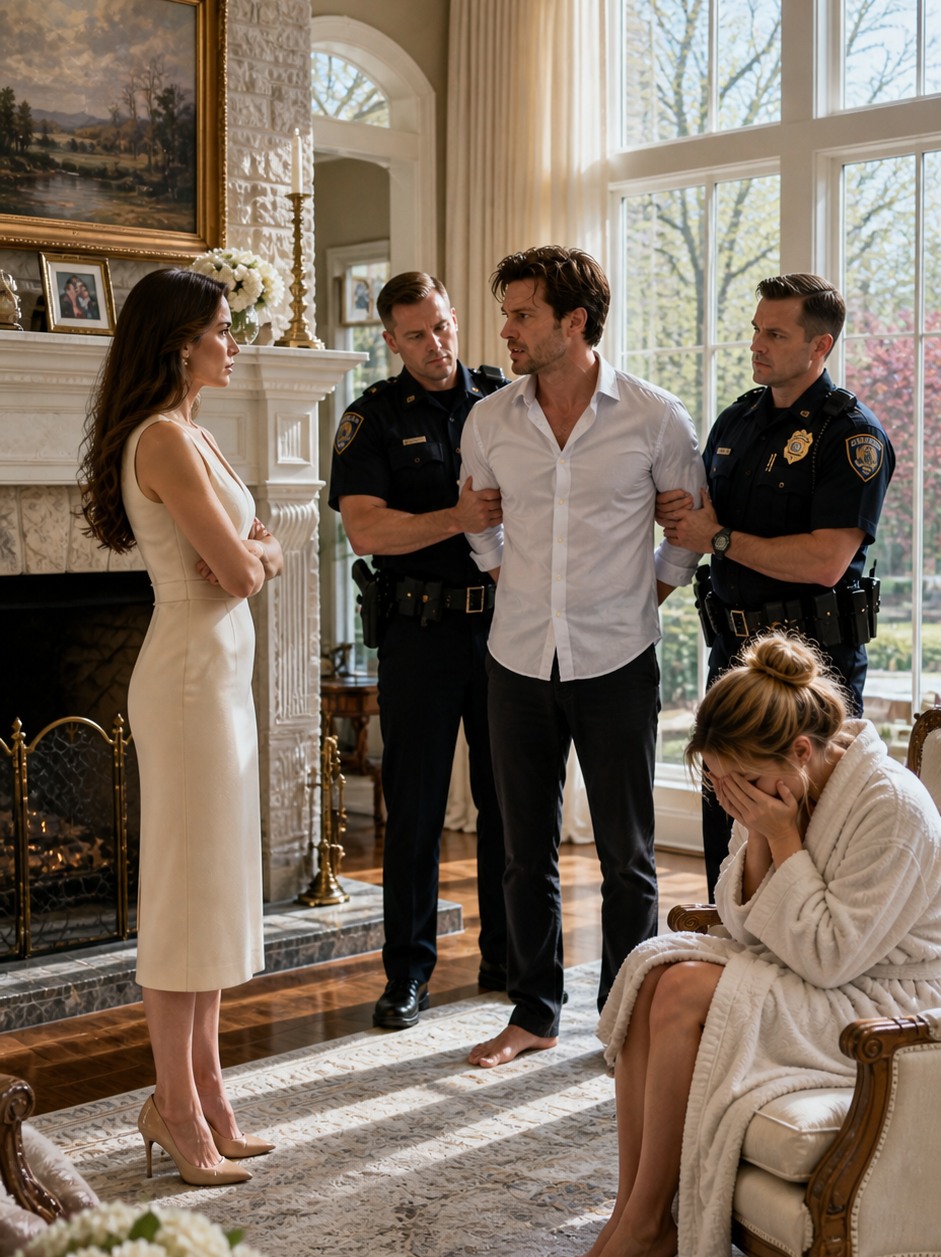
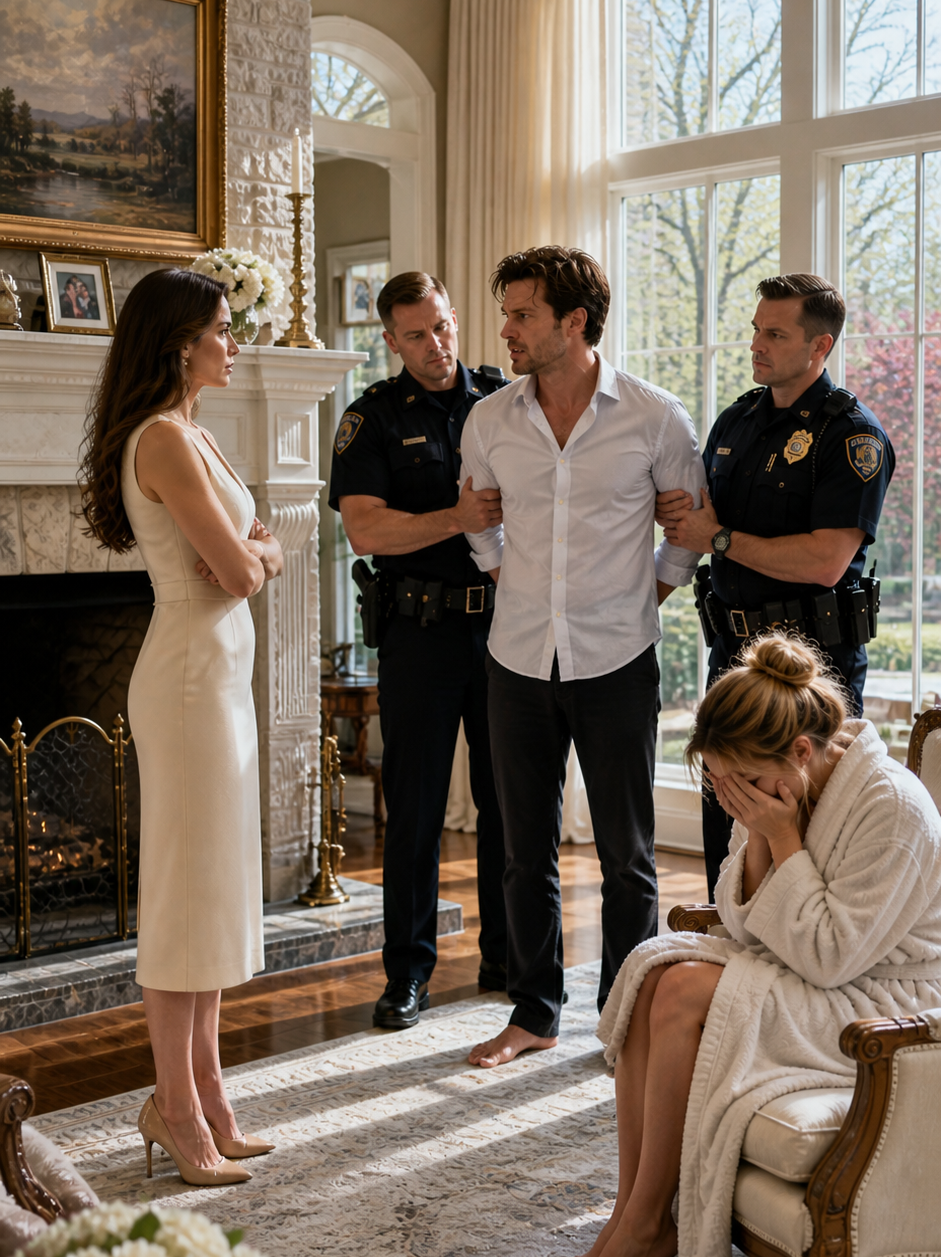
The police arrived twenty-three minutes later, along with my attorney, a private security team, and a representative from the trust office who looked deeply irritated to be standing in a snowstorm at midnight.
Grant had dressed by then, though his expensive sweater and dark trousers could not restore the authority he had lost while barefoot on the kitchen floor.
Sienna sat at the far end of the dining table with a blanket around her shoulders, no longer wearing my robe, her mascara smudged and her diamond ring resting beside a glass of untouched water.
My attorney, Rebecca Shaw, reviewed the preliminary documents with the calm brutality of a woman who charged by the hour and enjoyed being worth every dollar.
“Grant,” she said, “you are being served notice of asset restrictions, access revocation, and a temporary protective order regarding all Westbrook family properties and financial accounts.”
He looked past her at me. “Marina, please. We can settle this quietly.”
“You should have valued quiet before you filled my house with lies.”His expression softened artificially, the way it always did when he decided charm might still succeed.
“I made terrible mistakes, but I loved you.”
I looked around the kitchen, at the lilies, the digital frame, the mug, the ring, and the woman he had placed inside the outline of my life.
“No,” I said. “You loved access.”
The officers asked him to come with them for questioning, and for the first time since I had met him, Grant Caldwell had no assistant, driver, lawyer, or wife stepping forward to soften the moment.
He walked out through the snow in a borrowed coat.
Sienna left separately after giving a statement, and as she passed me in the foyer, she stopped.
“I am sorry,” she said. “I know that does not fix anything.”
“It does not,” I answered. “But tell the truth from this point forward, and at least your future will not be built entirely from his lies.”
When the door finally closed, the house became enormous.
Not peaceful.
Just empty.
Part 7: Firelight And Liquidation
I stood before the living-room fireplace after everyone had gone, holding the pearl silk robe Sienna had left folded over the back of a chair.
It smelled of lavender, sea salt, and another woman’s certainty.
For a moment, I remembered the night Grant had given it to me in Paris, how he had kissed the back of my neck and told me I deserved beautiful things.
Back then, I thought beauty meant being chosen.
Now I understood that beauty without truth was only decoration over rot.
I placed the robe into the flames and watched the silk darken, curl, and disappear.
My phone rang ten minutes later.
Rebecca’s voice came through crisp and alert. “The immediate filings are complete. Grant signed the emergency access acknowledgments in front of officers, and he cannot enter the property or contact you directly.”
“Good,” I said.
“Do you want me to arrange an inventory for the house?”
I looked at the room that had once seemed elegant and now felt staged for a woman who had been slowly edited out of her own life.
“Arrange liquidation.”
Rebecca paused. “Everything?”
“Everything movable,” I said. “Furniture, glassware, linens, artwork, decorative pieces, the espresso machine, the dining table, every object that participated in this performance.”
“Some of the art is personally meaningful.”
“Then donate it somewhere it can become meaningful again.”
There was a quiet breath on the line.
“And the house?”
I looked toward the windows, where snow covered the grounds in clean white silence.
“Sell it after the legal hold is lifted. I do not want to live inside a monument to someone else’s fraud.”
Part 8: The Montana Sky
Six months later, I woke before sunrise in Montana, in the old ranch house my father had left me outside a small valley town where the road signs were weathered, the air smelled of pine and cold grass, and nobody cared about deal flow, market multiples, or private equity gossip.
Grant had always hated the ranch.
He said it was inefficient, remote, and emotionally expensive, which meant it could not be easily converted into status.
That was exactly why I kept it.
Morning there did not begin with market alerts or calendar reminders.
It began with wind moving through the pines, horses shifting beyond the fence, and a sky so wide it made every old ambition look embarrassingly small.
I stood on the porch in worn jeans, an old wool sweater, and muddy boots, holding a heavy ceramic mug made by a local potter whose name I actually knew.
Grant had been sentenced for financial fraud, forgery, and related offenses, and though his attorneys had tried to frame him as a brilliant man who made desperate decisions under pressure, the evidence told a less flattering story.
Sienna cooperated fully and avoided prison, though her legal career ended before it had truly begun.
I did not hate her.
That surprised me.
She had been careless, vain, and willing to believe the version of reality that benefited her, but she had not built the machine.
Grant had.
My father once told me that a house built from money and lies eventually becomes a locked room.
I had dismissed him then, because I was young enough to mistake shine for strength and success for safety.
Now, standing beneath the enormous Montana sky, I understood him.
I was no longer Grant Caldwell’s wife, no longer the polished executive smiling beside him in photographs, no longer the woman who mistook being useful for being loved.
I was Marina Westbrook, and I had audited my own life with the same merciless clarity I once reserved for balance sheets.
The findings had been painful.
The recovery was beautiful.
Silence in Montana was not empty, because it held wind, horses, mountains, memory, and the honest sound of my own breathing.
For the first time in years, I felt rich in a way no account statement could measure.
I had lost the glass house.
I had found the ground.
THE END.