Chapter 1: The Woman on Mercer Street
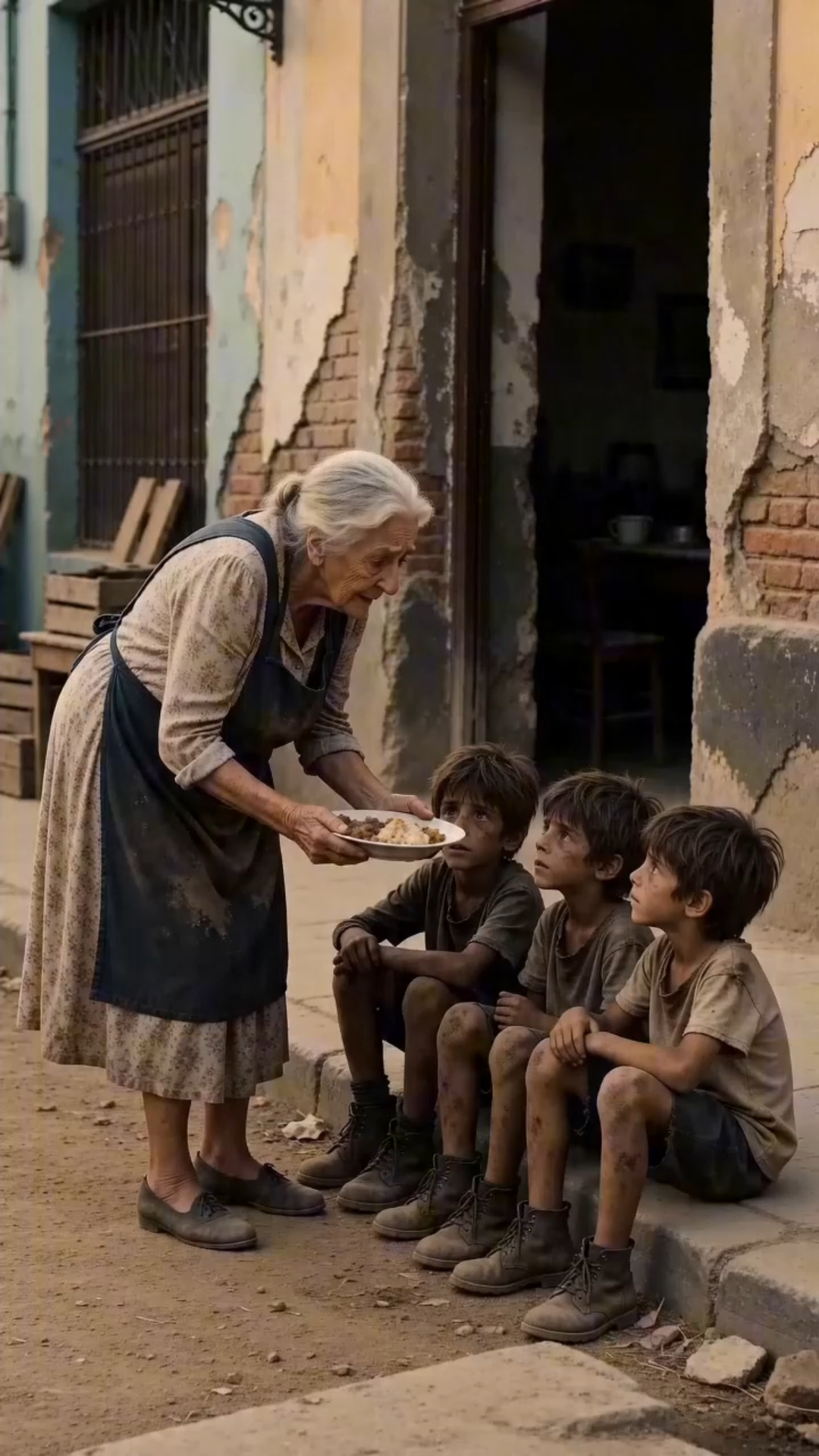
Every afternoon, before the factory whistle blew, Martha Hale carried a dented tray to the corner of Mercer Street and handed out whatever food she had. Most days, it was hard bread, thin stew, or boiled potatoes mashed with salt. It was never enough, but the children who waited for her never complained.
That morning, three little boys sat on the curb with blackened faces and torn shirts. Their knees were pulled to their chests, and their eyes followed Martha’s tray with the raw hunger of children who had learned not to ask for too much.
“Slowly now,” Martha said, lowering the tray. “If you eat too fast, you’ll be sick.”
The smallest boy nodded, though his hands were shaking. Martha broke the bread into equal pieces. She always made things equal, perhaps because life had never been fair to her.
Then the street exploded with noise.
Two black automobiles tore around the corner, tires grinding into the dirt road. Dust flew into the air, and Martha turned her face away, one arm raised to shield herself. When the dust settled, the cars stood in front of her, gleaming like they belonged to another world.
Three men stepped out.
They wore dark blue tailored suits, polished shoes, and heavy coats that probably cost more than Martha earned in a year. The boys stared as if kings had stepped from the cars.
Martha tightened her grip on the tray. Men like these did not come to streets like this unless they wanted something.
“Can I help you?” she asked carefully.
The tallest man stopped a few steps away. He looked at the tray in her hands, then at the hungry boys on the curb. His stern face softened, and his eyes reddened.
“You already did,” he said quietly.
Martha frowned.
“Years ago.”
The other two men lowered their heads. The leader stepped closer, his voice shaking.
“You fed us when we had nothing.”
Martha searched his face. Then she saw the thin white scar through his left eyebrow.
Her breath caught.
“Tommy?” she whispered.
The man gave a broken laugh.
Before she could say more, a harsh voice came from the doorway behind her.
“Martha. Who are these men, and what are they doing at my house?”
Chapter 2: The Husband Who Returned Too Late
Martha went still.
At the doorway stood Gerald Hale, her husband in name only. He had left years earlier, promising to find work in another town. He sent no money, no letters, no comfort. Yet every few months, he returned like bad weather, reminding Martha that misery could still claim legal rights.
The little boys on the curb lowered their heads and shuffled back. They knew the type.
Gerald looked from the black cars to the suited men, then to Martha’s wet eyes. Suspicion twisted his mouth.
“Well?” he demanded.
Martha wiped her cheek quickly. “They’ve come to ask something.”
Tommy said nothing. He was watching Gerald now, his old tenderness replaced by careful judgment.
Gerald noticed the tray and the scraps in the children’s hands. “You giving away our supper again?”
Martha did not answer.
Gerald sneered. “I leave for one week and come back to find you feeding gutter rats and entertaining rich strangers.”
One of the suited men stepped forward, but Tommy stopped him with a small motion.
“Mr. Hale,” Tommy said politely, “we are old acquaintances of your wife.”
Gerald laughed. “My wife doesn’t have acquaintances. She has debts.”
The words hit Martha harder than the wind. She lowered her head, used to swallowing humiliation.
But Tommy’s face changed.
“We knew her before she was your wife,” he said.
Gerald folded his arms. “And what business is that of yours?”
Tommy reached into his coat and removed an old folded paper, yellow with age. He opened it carefully.
Martha’s eyes widened.
It was a receipt. Twelve years old. Two loaves, one pot of broth, one blanket, three nights’ shelter. At the bottom, in her own handwriting, were the words:
Pay me back when life is kind to you.
Her hand flew to her mouth.
Gerald barked out a laugh. “So that’s it? You came all this way to settle a soup debt?”
“No,” Tommy said. “We came to settle a life debt.”
The youngest man spoke softly. “If she hadn’t taken us in that winter, we’d be dead.”
Gerald’s contempt shifted into greed.
“Well, then,” he said. “Martha’s my wife. What you give her, you give this household.”
Tommy looked at him for a long second.
“Then perhaps we should discuss the law,” he said.
Gerald’s smile slipped.
Tommy added, “Especially the part concerning a husband who has been collecting relief money in his wife’s name for seven years.”
Chapter 3: What Kindness Cost Her
Gerald went pale.
Martha looked from him to Tommy, struggling to understand what she had just heard.
“Relief money?” she repeated.
Gerald forced a laugh. “Don’t be ridiculous.”
Tommy’s voice remained calm. “The county widow’s relief. The coal ration subsidy. The church emergency fund. Veterans’ housing vouchers under false declaration. Shall I go on?”
Martha stared at Gerald. “Widow’s relief?”
He snapped, “It was paperwork. Means nothing.”
But Martha was already remembering. The church women who looked at her with pity. The landlord who strangely delayed eviction notices. The food vouchers that were always “lost in transit.” The half-burned letter she once found in the stove with her name on it.
Gerald had not only abandoned her.
He had profited from her abandonment.
Tommy stepped closer. “We hired an investigator before we came. We wanted to know whether the woman who saved us was living well. She wasn’t. Now we know why.”
Martha felt dizzy. The tray nearly slipped from her hands. One of Tommy’s men reached out to steady it, then stopped himself, careful not to touch her without permission. That small kindness almost broke her.
Gerald’s bravado cracked. “You rich men think you know everything because you can pay people to dig through records.”
“No,” Tommy said. “We know because we remember hunger, and we know the kind of people who create it.”
One of the boys on the curb had stopped eating, staring at Martha in fear. She set the tray down and took a breath.
“Is it true?” she asked Gerald.
He looked away.
That was answer enough.
Something long buried inside Martha rose quietly. Not rage. Something colder. Dignity.
Gerald muttered, “What now? You drag me to court over a few forms?”
Tommy almost looked sad. “You still don’t understand. This isn’t about the money.”
He nodded toward the second car. A driver removed a slim metal case. Inside were documents: property papers, bank certifications, and articles of incorporation.
The youngest man, Daniel, said, “We built a shipping firm. Started with scrap hauling, then warehouses, then rail freight.”
Tommy looked at Martha. “The first thing we ever owned was the blanket you gave us. We sold it in spring to buy tools.”
Martha’s eyes filled.
“We’ve come to take care of you,” Tommy said. “Properly. Publicly. Permanently.”
Gerald lunged toward the case. “As her husband, I—”
“No,” Martha said.
Everyone froze.
Her voice shook, but it did not break.
“I said no.”
Then Tommy opened the top file.
“Before we go further, Martha, you should know something. This boarding house doesn’t belong to your landlord anymore.”
She frowned.
Tommy met her eyes.
“It belongs to us. We bought it this morning. And Gerald has been stealing from more people than you.”
Chapter 4: The House of Debts
By late afternoon, half the street had gathered.
News traveled fast in poor neighborhoods, especially when black cars, rich men, and public disgrace arrived together. Women leaned from windows. Men stood near the curb. Children pretended to play while listening.
Gerald hated that most. Shame was unbearable to people who had pride but no conscience.
Tommy laid the documents across a wooden crate outside the door. Not for drama, but because he believed truth should be shown in daylight.
The boarding house records revealed months of forged signatures, withheld rent payments, stolen charity parcels, and false debts charged to widows and laborers. Gerald had been acting as an unofficial collector for the absentee landlord, skimming from everyone too poor to fight back.
Martha looked ill.
“He took Mrs. Donnelly’s coal money?” she asked.
“Three winters’ worth,” Daniel said.
“And Mr. Price’s pension advances,” Elias added. “And your sewing income.”
Martha closed her eyes.
Gerald burst out, “They would have lost it anyway! I kept this place running!”
“No,” a voice from the crowd snapped. “You kept us afraid.”
Old Mrs. Donnelly stepped forward with her cane. Others followed: a seamstress, a dockworker’s widow, two elderly brothers from the back room. For years, each had carried a private suspicion, a quiet humiliation, a fear of being disbelieved. Now the pattern stood exposed.
Gerald looked around, realizing too late that his power had depended on people suffering separately.
Tommy turned to Martha. “We’ve arranged legal counsel. If you want him charged, we will support it. If you want him removed and never near you again, we can do that too. The choice is yours.”
Martha looked at Gerald for a long moment. This was the man she had once waited for by the window. The man she had excused. The man whose return she had feared and hoped for because loneliness can make cruelty look like fate.
Now he just looked small.
“I want him gone,” she said.
Gerald stared at her. Then he laughed bitterly. “And where will you be without me?”
Tommy answered, “Safe.”
Two local officers stepped from the second car.
Gerald backed away. “This is madness. Over old soup and street brats?”
Tommy’s gaze sharpened. “Not over soup. Over the fact that when the world let three boys starve, one poor woman fed them anyway. Men like you count on kindness being weak. You were wrong.”
As the officers led Gerald away, he shouted, “Rich men always want something!”
Martha flinched.
Tommy heard it.
He turned to her gently. “He’s wrong. But there is something we want.”
Martha looked at him warily.
“We want you to come with us tomorrow. There is a building downtown with your name waiting over the door.”
Chapter 5: The Name Above the Door
The next morning, Martha wore the only clean dress she had not already patched twice.
She nearly refused to go. Women like her were not driven downtown in chauffeured cars. They did not belong in marble districts or sit before reporters. But Tommy had asked, not ordered, and Martha had lived too much of her life in fear.
So she went.
The building stood near the freight yards, renovated but not extravagant, with brick walls, wide windows, and a fresh sign covered by a white cloth. A small crowd had gathered: reporters, workers, church representatives, and several women from Martha’s boarding street.
“What is this?” Martha whispered.
Tommy helped her from the car as carefully as if she were royalty. Daniel and Elias stood beside him, both trying not to cry.
Tommy faced the crowd.
“Twelve years ago,” he said, “three hungry boys were fed by a woman who had almost nothing. She did not ask our names. She did not ask what use we might be. She only saw that we were starving and chose mercy.”
He turned toward Martha.
“We built a company. Today, we intend to build something better.”
He pulled the cloth away.
The sign read:
THE MARTHA HALE HOME FOR WOMEN AND CHILDREN
Martha covered her mouth.
Elias explained that the building would serve widows, abandoned mothers, and hungry children. Temporary rooms. Hot meals. Job training. Legal help. Medical referrals. No one would be turned away for lack of money. Daniel added that the first ten years had already been funded.
Martha shook her head. “I don’t know how to run a place like this.”
Tommy smiled. “You already do. You’ve been doing it on a street corner with a soup tray.”
The crowd applauded, but Martha barely heard it. Her eyes fixed on the bronze plaque beneath the sign.
In gratitude to the woman who fed us when no one else did.
Later, Martha stood alone in the bright kitchen, surrounded by new pots, flour, bread, and clean shelves.
Tommy found her there.
“You gave us too much,” she said softly.
He shook his head. “No. We gave back too little, too late.”
Martha studied him. “Why did you really come yesterday?”
Tommy hesitated, then took out the old receipt. On the back, written in a child’s uneven hand, were three words:
We found you.
“We’ve been looking for you for five years,” he said. “We only found this street because one boy you fed last winter recognized me in a newspaper.”
Martha laughed shakily through tears. “So one hungry child led you back.”
“Yes,” Tommy said.
Then he looked toward the doorway, where three street boys stood peeking in.
“Which means,” he said quietly, “perhaps our story is only beginning.”