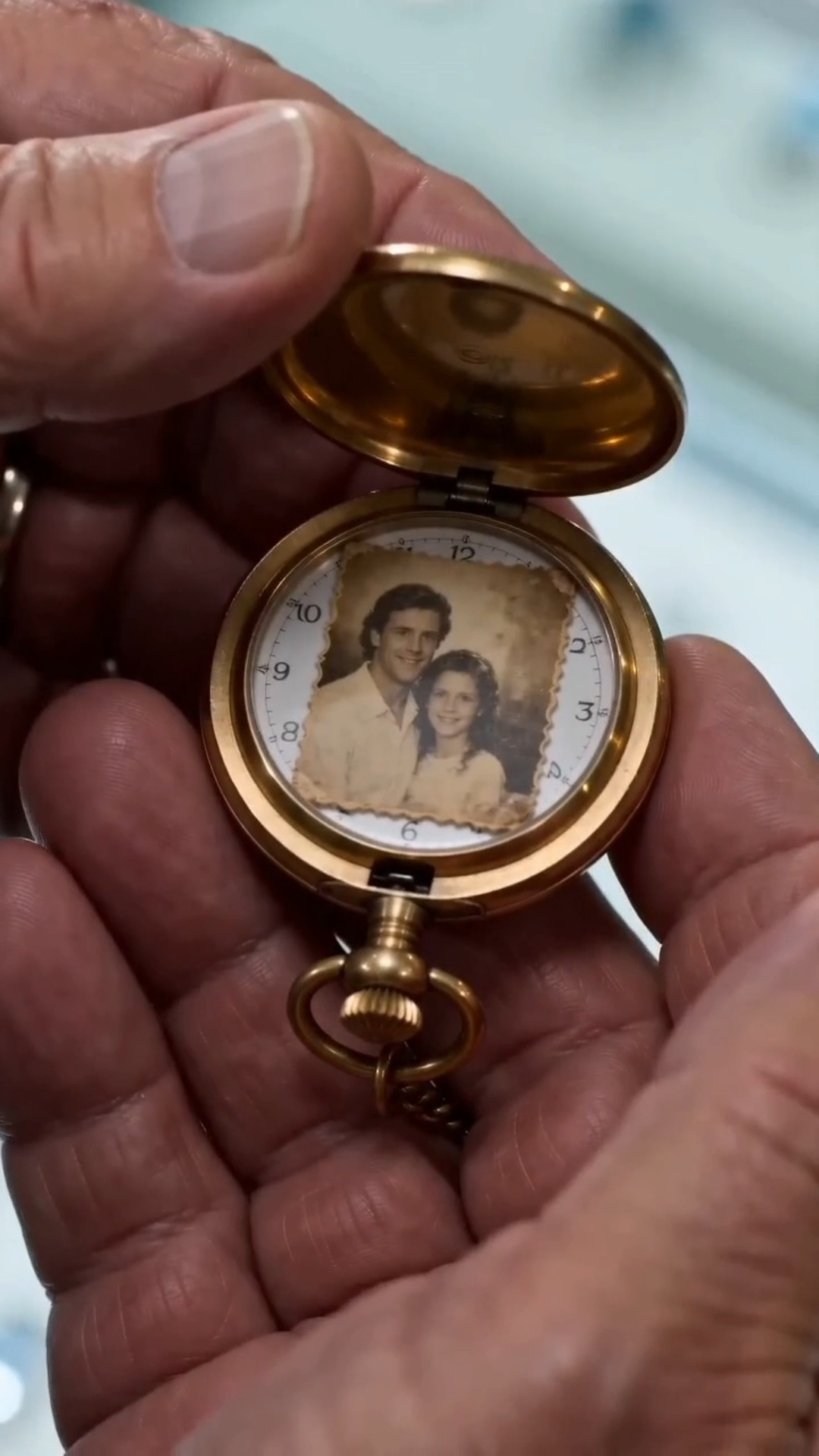
Chapter 1: The Golden Watch
“My mom is sick. She needs medicine. She said to sell this.”
The boy stood on tiptoe at the jewelry counter, holding up a golden pocket watch with both hands. He looked no more than seven. His coat was thin, his cheeks pale, and his eyes carried the worry of a child trying too hard to be brave.
Old Mr. Henry Whitmore adjusted his glasses and took the watch.
At first, he only noticed the scratched gold case.
Then he opened it.
His hands began to shake.
Inside was a tiny photograph of a young couple. Henry stared at the woman in the picture, unable to breathe. She had the same bright eyes and soft smile he had remembered every day for twenty-two years.
His daughter.
Emily.
“Where did your mother get this?” Henry asked, his voice breaking.
The boy frowned. “She has always had it.”
Henry gripped the counter. “I gave this to my daughter. She vanished years ago.”
The boy’s eyes widened. “My mom said she had no family.”
“What is your mother’s name?”
“Emma,” the boy whispered. “Emma Reed.”
Henry almost dropped the watch. Emily Whitmore had disappeared after running away with a man named Daniel Reed. For years, Henry had searched for her. Then a letter arrived saying she had died overseas. No body. No grave. Only enough grief to make him stop hoping.
Now this boy had her watch.
And her eyes.
Before Henry could speak again, the bell above the shop door rang.
A tall man in a dark coat stepped inside. He wore black gloves and a smile too smooth to trust.
The boy went still.
“There you are, Noah,” the man said. “Your mother has been looking for you.”
Noah backed into the counter.
“No,” he whispered. “Mom told me to run if he found me.”
Henry closed the watch and slipped it into his pocket.
The stranger’s smile disappeared.
“Old man,” he said coldly, “that watch does not belong to you anymore.”
Chapter 2: The Letter in the Boy’s Coat
Henry moved Noah behind him.
The jewelry shop was small, but Henry knew every inch of it. He knew which drawer held the alarm button, which display case had loose hinges, and which silver candlestick on the counter was heavy enough to be useful.
The stranger noticed his hand moving.
“I would not do that,” he said.
Henry kept his eyes on him. “You still have not told me who you are.”
“My name is Victor Voss,” the man said. “I was asked to retrieve the boy and the watch.”
“By his mother?”
“By people who know what is best for him.”
Noah gripped Henry’s coat. “He came yesterday. Mom locked the door. He said if she did not give him the watch, the medicine would stop.”
Henry felt anger rise in him.
Noah suddenly tugged his sleeve. “Mom gave me something else.”
Voss’s eyes sharpened.
Noah reached into the lining of his torn jacket and pulled out a folded paper. It had been stitched inside with uneven thread.
Voss lunged.
Henry grabbed the candlestick and struck his wrist. Voss cursed, and Noah ducked behind the counter. Henry snatched the letter and opened it.
The handwriting was weak.
But he knew it.
Father, if this reaches you, I am alive. I was told you rejected me. I believed it for years. Daniel is dead. Noah is my son. The people from Harrow House are coming for him. Do not trust Victor Voss.
Henry’s eyes blurred.
Emily was alive.
The bell rang again.
A police officer stepped inside. Henry had pressed the silent alarm after all.
Voss’s expression changed instantly. “Officer, thank goodness. This elderly man is keeping a child from his legal guardian.”
The officer moved toward him. “Sir, stay where you are.”
Voss looked at Noah.
“You should have listened to your mother,” he said. “Now she will pay for this.”
Suddenly, smoke burst from a small device in his hand.
The shop filled with gray fog.
When it cleared, Voss was gone.
So was the golden watch.
Only Noah remained, shaking behind the counter, holding a torn paper from Voss’s pocket.
On it was one address.
Harrow House.
Chapter 3: Harrow House
Henry had not heard the name Harrow House in decades.
It had once been called a private recovery estate for troubled young women. Wealthy families sent daughters there after scandals, breakdowns, unwanted pregnancies, or marriages they regretted. Everyone knew it existed. No one admitted what happened inside.
Emily had vanished the same summer Henry refused to approve her marriage to Daniel Reed.
He had always believed she ran away.
Now he wondered if she had been taken.
The police wanted Henry to wait. They said they needed warrants and confirmation. Henry listened for three minutes, then put Noah into his old car and drove north.
Noah sat beside him, holding Emily’s letter.
“Is she really your daughter?” he asked.
Henry’s throat tightened. “Yes.”
“Then you are my grandpa?”
The question nearly broke him.
“I think so,” Henry said.
Harrow House stood beyond iron gates on a wooded hill. The stone walls were pale, the windows narrow, and a blue medical van waited near the side entrance.
They parked behind trees and approached on foot.
Through a ground-floor window, Noah suddenly stopped.
“There,” he whispered.
Henry looked inside.
A woman lay in a narrow bed, pale and thin, her dark hair spread across the pillow.
Emily.
Noah pressed his hands to the glass. “Mom.”
Henry tried the window.
Locked.
Then Victor Voss entered the room, holding the stolen golden watch. He opened it and removed something hidden behind the photograph.
A key.
Henry stared.
He had never known the watch contained one.
Voss leaned over Emily and spoke. Emily turned her head weakly away.
Noah began to cry.
Henry pulled him back. “We need help.”
“No,” Noah whispered. “They will move her.”
He pointed to the medical van. Two orderlies were already loading supplies.
Then Voss turned toward the window.
His eyes met Henry’s.
He smiled.
Floodlights snapped on across the lawn.
Dogs barked.
The gates behind them slammed shut.
A speaker above the door crackled.
Voss’s voice rang out calmly.
“Welcome home, Mr. Whitmore.”
Chapter 4: The Secret Behind the Watch
Henry grabbed Noah’s hand and ran.
For a seventy-year-old man, fear gave him strength. He pulled the boy through wet hedges and around the side of Harrow House as dogs barked behind them. Guards shouted from the drive. A searchlight swept across the lawn, missing them by inches.
Noah suddenly tugged him toward a cellar door hidden beneath ivy.
“Mom told me,” he whispered. “If I ever came here, find the red door.”
The door had been painted black, but red showed beneath the peeling paint.
Henry kicked it until the rusted latch broke.
They stumbled inside.
The cellar smelled of bleach, damp stone, and old secrets. Noah led him down a narrow passage. At the end of the hall, voices echoed.
Voss.
And Emily.
Henry froze outside a half-open door.
Emily’s voice was weak but clear. “My father will find us.”
Voss laughed. “Your father believed you were dead because we gave him a letter and a grave he never opened. Men believe what hurts too much to question.”
Henry closed his eyes.
A grave.
They had given him a grave.
Voss continued, “Your father’s watch contains the final key to the Whitmore trust. Without it, Harrow House could never claim your inheritance. Now we have the key, the heir, and the boy.”
Noah looked terrified.
Emily said, “You will not touch my son.”
Voss replied, “Your son is valuable. Whitmore blood. Reed blood. Legal claim to both estates.”
Henry could not listen anymore.
He pushed the door open.
Emily turned her head.
For a moment, father and daughter stared at each other across twenty-two stolen years.
“Emily,” Henry whispered.
“Daddy?”
Voss lifted a pistol. “You should have stayed in your shop.”
Then Noah grabbed a glass bottle and threw it at the wall.
It shattered against a red alarm switch.
Sirens screamed.
Sprinklers burst to life. Doors unlocked. People shouted upstairs.
Henry rushed to Emily and untied her wrists.
Voss raised the gun.
A shot cracked.
But Voss was the one who fell back, bleeding from the shoulder.
Behind him stood the police officer from the jewelry shop.
Then Emily saw the watch in Voss’s hand.
“The key,” she whispered. “It does not open money.”
Henry frowned. “Then what does it open?”
Emily looked toward the iron door at the end of the basement.
“The room where they kept the children.”
Chapter 5: The Children’s Room
The iron door had no handle.
Only a small golden keyhole.
Henry picked up the watch, opened the hidden back, and removed the tiny key. His hands shook as he placed it into the lock.
For one terrible second, nothing happened.
Then the door clicked.
Behind it was not a prison cell.
It was a record room.
Shelves covered the walls. Boxes, files, photographs, birth certificates, medical reports, and adoption papers filled the room. On one wall hung dozens of children’s portraits with numbers instead of names.
Emily leaned against Henry, breathing hard.
“This is how they erased us,” she whispered.
Noah found the first box because it had his mother’s old name on it.
Emily Whitmore.
Inside were letters Henry had written every month after she disappeared. None had reached her. There were photographs of Noah as a baby, medical reports on Emily’s illness, and legal forms declaring her mentally unfit.
Henry’s guilt nearly crushed him.
“I wrote to you,” he said.
Emily touched one of the letters. “I thought you hated me.”
“I thought you were dead.”
Then Noah pulled another folder from the shelf.
“Grandpa,” he said quietly. “There are more.”
There were hundreds.
Women declared unstable. Children renamed. Inheritances redirected. Families separated and fed lies until grief became silence.
By dawn, the police had taken over Harrow House. Voss survived and was arrested. Several doctors and lawyers were taken too. The files became evidence in a massive criminal investigation.
Emily spent three weeks in the hospital.
This time, no one kept Henry away.
Noah visited every day, always carrying the golden watch. He refused to sell it now. Henry repaired it but did not polish it. The scratches mattered.
Months later, Emily stood inside Henry’s jewelry shop for the first time since she was nineteen.
Noah ran behind the counter and announced that one day the shop would be his.
Henry laughed, then cried.
The golden watch rested in the display case, open to the photograph.
Beside it was a small sign:
Not for sale.
One evening, Noah asked, “Why did Mom send me here with the watch?”
Emily answered softly, “Because I knew your grandfather would remember love faster than pain.”
Henry reached for her hand.
This time, she let him hold it.