Chapter 1: The Photograph
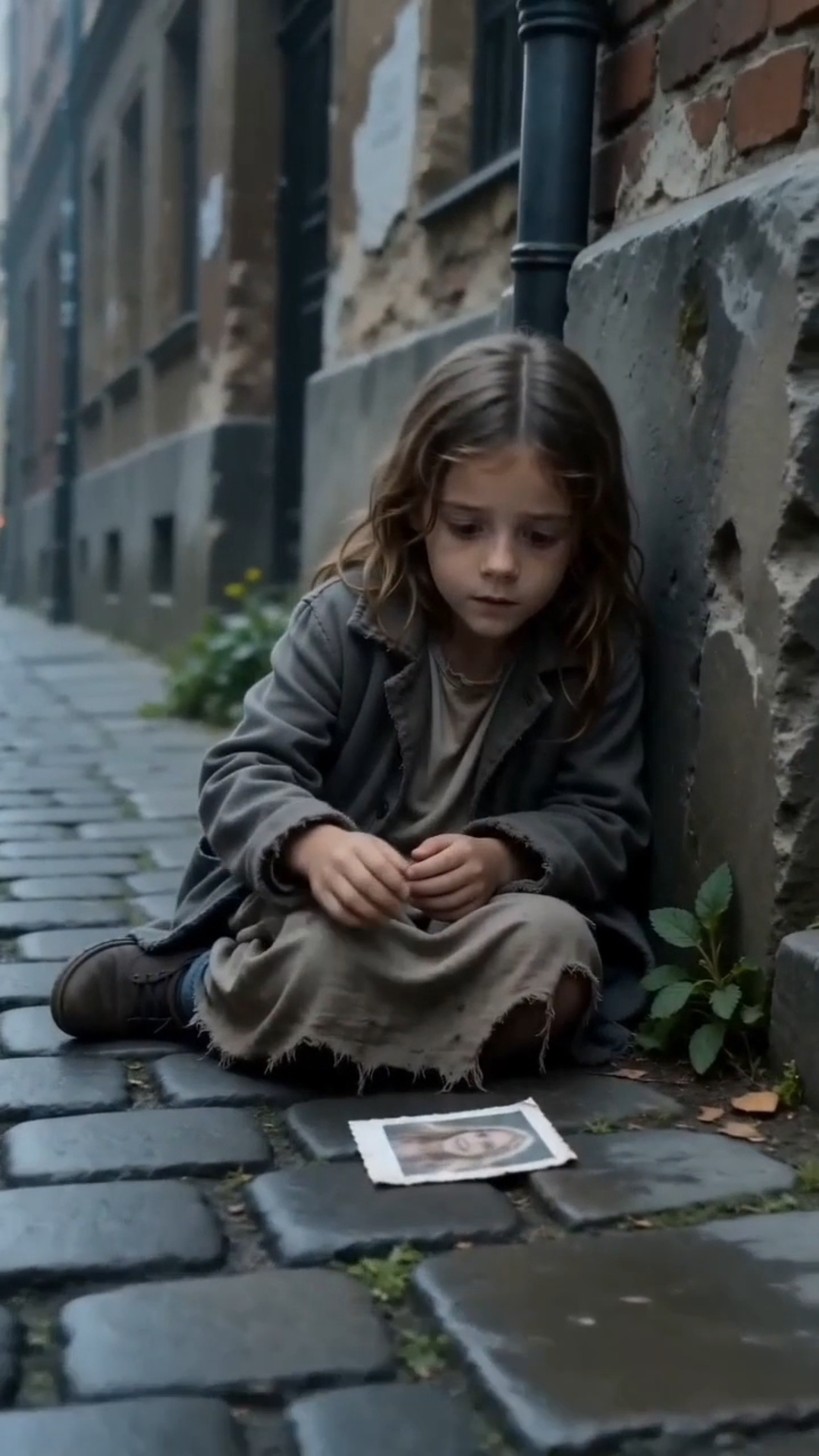
“Mister, why do you have a picture of my mommy?”
The question stopped Gabriel Laurent in the middle of the cobblestone street.
He turned sharply, his hand moving to the inside pocket of his coat, only to realize the photograph was gone. A little girl stood behind him, barefoot despite the cold morning, her dress torn, her hair tangled by the wind. She could not have been older than six. In her hand was the photograph he had carried for years: the only picture he still kept of his wife, Isabelle.
Gabriel stared at her. The street noise faded behind the pounding of his heart.
“What did you say?” he asked.
The girl lifted the photograph higher. “My mommy. Why do you have her picture?”
Gabriel stepped closer, slowly. Up close, he noticed her eyes first. Gray-green. Isabelle’s eyes. The same quiet shape. The same solemn depth.
“That is my wife,” he said, his voice rough. “She died years ago.”
The girl’s expression did not change.
“No,” she said softly. “My mom is alive.”
Gabriel felt something cold spread through his chest. Six years earlier, he had buried Isabelle without seeing her body. The carriage accident had left the wreck burned and twisted. His father had insisted the remains were too badly damaged. The coffin was sealed. The priest spoke. Gabriel stood there like a man already half dead.
He had doubted it once. Then time turned the unbearable into habit.
Now this child had torn it open with one sentence.
“What is your name?” he asked.
“Lila.”
“And your mother? What does she call herself?”
The girl hesitated. “Mama says not to tell strangers too much.”
Gabriel knelt so they were eye level. “If your mother is the woman in that picture, I need to find her.”
Lila searched his face. Then she whispered, “She said if I ever saw the man from the picture, I should ask if he still wears the silver ring.”
Gabriel’s breath caught.
He looked at his left hand. He still wore it. The plain silver wedding band Isabelle had given him twelve years ago.
When he looked up again, Lila’s eyes were full of sorrow.
“Then it’s really you,” she said.
A carriage rolled into the street behind them. Lila suddenly stepped back, fear flashing across her face.
“Don’t look now,” she whispered. “The man with the black cane has seen us.”
Gabriel turned anyway.
At the far end of the street stood his older brother, Lucien.
And Lucien was staring straight at the child.
Chapter 2: The House by the River
Lucien Laurent did not smile when he saw Gabriel.
That alone made Gabriel uneasy. Lucien always smiled. At funerals, at dinners, during arguments, even when delivering bad news. His charm softened everything sharp in the world.
But now his expression had gone still.
Gabriel rose quickly. “Lila, stay behind me.”
The girl obeyed at once, pressing herself against his coat as Lucien approached, his black cane clicking against the stone.
“Gabriel,” Lucien said lightly, though his gaze went straight to the child. “I did not expect to find you here.”
“I could say the same.”
Lucien’s eyes settled on the photograph in Gabriel’s hand. “You dropped something important.”
Before Gabriel could answer, Lila clutched his sleeve and whispered, “He comes sometimes.”
Gabriel turned sharply. “To see your mother?”
Lila nodded once.
Lucien’s face changed by the smallest degree. Anyone else would have missed it. Gabriel did not.
“What exactly is this?” Lucien asked.
“I was about to ask you that,” Gabriel said. “This child says Isabelle is alive.”
Lucien looked almost startled.
Then the mask returned.
“Children say strange things,” he replied. “And grief makes men hear what they want.”
“She recognized Isabelle from a photograph.”
Lucien glanced down at Lila. “Did she?”
The girl’s fingers dug into Gabriel’s sleeve. She was trembling.
“Come,” Lucien said quietly. “Where is your mother today?”
Lila buried her face against Gabriel’s arm.
Something inside Gabriel hardened.
“You’re not asking her another question,” he said. “You will answer mine first. Why do you know this child?”
Lucien’s smile returned, thin and cold. “Because I make it my business to know what threatens this family.”
Gabriel stared at him.
Lucien lowered his voice. “If you care for your peace, walk away now.”
That was answer enough.
Gabriel took Lila’s hand. “Take me to your mother.”
Lila looked up, uncertain.
“Can I trust you?” she whispered.
“Yes.”
Lucien laughed softly behind them. “If you take one more step, Gabriel, you will regret what you find.”
Gabriel did not stop. Lila led him through narrow streets toward the river quarter, past shuttered bakeries, damp courtyards, and leaning buildings. At last, they stopped before a faded boarding house with cracked blue shutters.
“This is where we stay,” Lila said.
They climbed to the third floor.
The room was small but neat. A bed, a stove, two chipped mugs, a folded blanket. On the windowsill sat a vase with one dying wildflower. Everything about it struck Gabriel hard because it looked like Isabelle’s quiet effort to make poverty dignified.
But Isabelle was not there.
The bed was still warm.
On the pillow lay a note.
Gabriel unfolded it with shaking hands.
If Lucien finds her, do not let him take Lila to Harrow House.
Gabriel read the line twice.
“Lila,” he said carefully, “where is your mother now?”
The child looked toward the window, eyes filling with tears.
“He took her this morning,” she whispered. “Mama told me if she didn’t come back by noon, I had to find the man in the picture.”
Chapter 3: The Woman in Room Twelve
Gabriel had not heard the name Harrow House in six years.
It had been his father’s convalescent estate outside the city, once used for private recoveries and scandals wealthy families preferred to hide. After Isabelle’s death, the place had been closed, at least officially. His father died two years later. Lucien inherited the Laurent properties, including Harrow House, though he always claimed it stood empty.
Now Gabriel drove there like a man chasing his own ghost.
Lila sat beside him in silence, clutching the photograph. Once or twice she looked at him as if she wanted to speak, then thought better of it. Gabriel did not press her. His own thoughts were in ruins.
By the time they reached the gates, rain had begun to fall.
The estate stood on a low hill above the river, gray stone under a gray sky. The lower windows were dark, but one curtain moved on the second floor. Gabriel drove through the gates without waiting for permission.
A groundskeeper came running out, protesting, then stopped when he recognized him.
“I want Lucien,” Gabriel said.
The man hesitated. “Mr. Lucien is not receiving visitors.”
Gabriel stepped closer. “Then I will visit the entire house.”
Footsteps sounded behind him. Lucien emerged from the front hall, immaculate as always, one hand on his black cane.
“You should not have brought the girl here,” he said.
Gabriel’s pulse thundered. “Where is Isabelle?”
Lucien remained calm. “Dead.”
Lila let out a frightened sound and hid behind Gabriel.
“You lie too easily,” Gabriel said. “You always did.”
Lucien’s gaze flicked toward the upper windows. “There are truths this family survived only because they stayed buried.”
Gabriel shoved past him.
Lucien caught his arm. “If you go upstairs, you will destroy what little is left.”
Gabriel struck his hand away. “Move.”
Something dark flashed in Lucien’s eyes. Not anger. Resignation.
“Room twelve,” he said.
Gabriel froze.
Lucien stepped back, voice low. “You will not believe me now, so go see for yourself.”
Gabriel ran.
The upper corridor smelled of medicine and lavender. At number twelve, his hand hesitated only a second before he pushed the door open.
A woman sat by the window in a pale dress, her hair longer than he remembered, her shoulders thinner, her face turned partly away.
At the sound of the door, she looked up.
Time broke.
It was Isabelle.
Older. Fragile. Achingly real.
For a heartbeat neither moved.
Then Lila slipped past Gabriel with a cry.
“Mama!”
Isabelle rose so quickly her chair overturned. She caught the child and held her tightly as both began to sob.
Gabriel could not breathe.
At last Isabelle lifted her face to his.
There was recognition there.
Pain too.
But not joy.
Her eyes filled as she whispered the words that hollowed him out.
“You should not have come. He told me you knew.”
Chapter 4: The Lie Between Them
Gabriel stood motionless while rain tapped against the window and Lila clung to her mother.
“Knew what?” he asked.
Isabelle sat slowly, keeping one arm around the child as though afraid someone might take her. She looked at Gabriel the way people look at light after years underground: wanting it, doubting it, fearing what it reveals.
Lucien entered a moment later and closed the door.
For once, Gabriel was grateful. There would be no more shadows now.
“Tell him,” Gabriel said.
Lucien said nothing.
Isabelle answered instead.
“After the carriage went over the ravine, I woke up here. I had lost days, maybe weeks. Lucien told me you had signed the burial papers. He told me you had accepted money from your father to make sure I never came back.”
Gabriel stared at him. “What?”
Lucien’s jaw tightened.
Isabelle continued, voice unsteady. “He said your father never wanted me in the family. That the accident was arranged to frighten me, but I survived by mistake. He said if people learned I was alive, they would finish what they started. Then I discovered I was pregnant.”
Gabriel looked at Lila, and something inside him gave way.
Lucien spoke at last. “Father arranged the accident. That part was true.”
The room went still.
Gabriel turned slowly. “You knew.”
“Afterward,” Lucien said. “Not before.”
“And you kept her here?”
“I kept her alive.”
Gabriel nearly laughed from rage. “You imprisoned her.”
Lucien’s eyes flashed. “Father had judges, doctors, police, priests. He controlled every account, every deed, every story. By the time I learned the truth, the funeral had happened. Isabelle was supposed to be dead. If she reappeared carrying your child and accusing him, he would have destroyed all three of you.”
“He is dead now,” Gabriel said.
“Yes,” Lucien replied quietly. “And who held this family together after he died? Who paid his debts? Who kept his men from coming back for the child? Me.”
The words struck harder than Gabriel wanted them to.
Isabelle looked between them, tears trembling. “All these years, I did not know which one of you had betrayed me.”
Lucien let out a bitter breath. “That was the problem. I betrayed you by saving you the only way I knew how.”
Lila pressed closer to her mother.
Gabriel went to Isabelle slowly. “I never stopped looking for you,” he said. “Even after they buried that empty coffin. Even after everyone told me to stop.”
Isabelle’s face crumpled.
“Then why didn’t you come?” she whispered.
“Because I didn’t know where to look.”
Lucien turned toward the window.
“I know what you want,” he said. “A monster. A villain. But if you leave tonight, Father’s old associates will know she is alive by morning.”
Gabriel’s voice turned cold. “Then let them know.”
Lucien shook his head. “You still don’t understand. Father’s associates are not the danger now.”
He drew out a folded document.
Gabriel took it.
At the top was a recent legal notice.
Petition for custody of minor child Lila Moreau Laurent.
Filed by: Madame Celeste Valen.
Gabriel frowned. “Who is that?”
Lucien looked at Isabelle.
And Isabelle went white.
“My mother,” she whispered.
Chapter 5: The Woman Who Wanted the Child
Madame Celeste Valen arrived at Harrow House before sunset.
She came in a black carriage trimmed in silver, like a woman attending a funeral she intended to enjoy. Gabriel had met her only twice before his marriage. Isabelle’s mother had disapproved of him from the beginning, calling him reckless, beneath their station, too sentimental to survive among powerful men. When Isabelle married him anyway, Madame Valen cut her off publicly.
Now she entered the drawing room as though she owned every silence in it.
She was elegant even in old age, with a straight back, gloved hands, and eyes sharp enough to skin a person alive. The moment she saw Lila, something hungry flickered across her face.
“There she is,” she said softly. “My granddaughter.”
Lila hid behind Gabriel.
Celeste’s expression cooled. “I see the child has been poorly guided.”
Gabriel stepped forward. “You filed for custody.”
“I filed for protection,” Celeste corrected. “That child belongs with blood, name, and means. Not hidden in river slums or trapped in this house of old sins.”
Isabelle rose from her chair, pale but steady. “You knew I was alive.”
Celeste did not deny it.
“I knew enough,” she said. “Lucien brought word years ago.”
Gabriel turned on his brother, but Lucien held his gaze.
“I told her only after Father died,” he said. “I needed someone powerful enough to keep his business partners away.”
Celeste gave a faint smile. “And I did.”
“By keeping my daughter from me?” Isabelle asked.
“By keeping you breathing.”
The room held its breath.
Celeste removed one glove finger by finger. “You were never capable of protecting a child, Isabelle. You chose love over sense, then nearly died for it. I was not going to entrust that little girl to sentiment.”
Gabriel felt Lila’s small hand tighten in his.
“You had no right,” he said.
Celeste looked at him as though he were furniture. “Rights are for those weak enough to need permission.”
Isabelle stepped closer. For the first time, her mother seemed to realize something had changed. The frightened woman in room twelve was gone.
“You lost the right to speak for me the day you let them bury me,” Isabelle said.
Celeste’s face hardened. “I let them protect what could be saved.”
“No,” Isabelle answered. “You protected your reputation.”
The silence was absolute.
Then Lucien crossed the room and placed a leather folder in Gabriel’s hand.
“Father’s ledgers, letters, names of every man who helped him. Also the letters Celeste kept from Isabelle. I copied everything.”
Gabriel stared. “Why now?”
Lucien looked at Lila.
“Because I am tired of raising this family through fear.”
Celeste took a step forward. “You ungrateful fool.”
Lucien faced her. “No. Just late.”
By midnight, the police had been called. Not the men once owned by Laurent money, but magistrates from the capital Lucien had contacted months earlier in secret. Celeste left Harrow House not with a granddaughter in her carriage, but under formal investigation. Father’s old network began to collapse within weeks.
The rest took longer.
Trust. Forgiveness. Memory. None of it returned in one night.
But the next morning, Gabriel found Lila asleep in Isabelle’s lap by the window, both wrapped in a blanket, sunlight touching their faces. Isabelle looked up at him with tired eyes and a quiet sadness that no longer felt like distance.
“You still wear the ring,” she said.
Gabriel smiled faintly. “I was waiting to ask whether I should.”
Isabelle reached for his hand.
“This time,” she whispered, “ask me when there are no lies in the room.”
Months later, he asked again in a small chapel by the river, with Lila holding the flowers and Lucien standing at the back, silent.
And this time, Isabelle said yes.